Follistatin-344
Follistatin-344 (FST-344) is the longer alternatively-spliced isoform of human follistatin, a secreted regulatory glycoprotein encoded by the FST gene (canonical UniProt P19883).
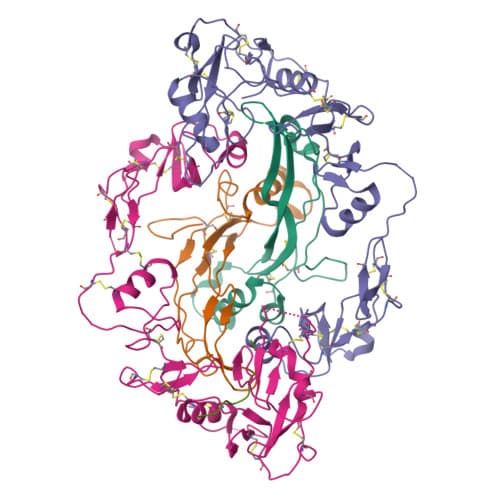
Identity & structure
- Signal peptide (residues 1–29; removed in the mature FS-315 chain)
344-residue primary translation product, including the 29-residue signal peptide (residues 1–29). After signal-peptide cleavage the mature secreted protein is 315 residues (FS-315, residues 30–344) — the “344” is a precursor count, not a mature-chain length.
| Identity | |
|---|---|
| Type | Protein |
| Also known as | FST-344, FS-344, Follistatin 344, Follistatin isoform FST344, Activin-binding protein, Follistatin, FST |
| CAS | Not asserted — not cleanly resolved to this isoform (pending verification) |
| PubChem CID | Not assigned — a protein of this size receives no small-molecule PubChem CID |
| UniProt | P19883 — canonical 344-aa isoform |
| Research class | Regenerative & Cytoprotective |
| Structure | |
| Length | 344 aa (precursor); mature chain 315 aa |
| Molecular formula | Not applicable — glycoprotein; mass heterogeneous |
| InChIKey | Not assigned — proteins are outside InChI’s practical domain |
| PDB | 2P6A, 2B0U |
| Analytical | |
| Monoisotopic mass | Not applicable — glycoprotein; mass heterogeneous |
Mass basis (glycoprotein — no single exact mass)
- 344-aa precursor, unglycosylated (incl. signal peptide)38,006.79 Da (UniProt calc.)
- Mature FS-315 polypeptide (res 30–344), unglycosylated~34.7 kDa (calc.)
- Native/recombinant glycoprotein (SDS-PAGE apparent)~40–50 kDa
Follistatin is heavily disulfide-bonded (every cysteine is paired) and glycosylated: recombinant mature follistatin migrates at roughly 40–50 kDa on SDS-PAGE, above its ~34.7 kDa polypeptide mass, because of attached N-linked glycans (N-X-S/T sequons in the precursor). Because the glycans are heterogeneous, no single exact molecular formula, monoisotopic mass, or InChIKey applies; the identity is captured by the sequence and the UniProt and PDB cross-references.
Reference context
Follistatin-344 (FST-344) is the longer alternatively-spliced isoform of human follistatin, a secreted regulatory glycoprotein encoded by the FST gene (canonical UniProt P19883). The “344” is the length in amino acids of the primary translation product, counting the 29-residue signal peptide; once that signal peptide is removed, the mature secreted protein is 315 residues (FS-315, residues 30–344). A shorter splice isoform gives the 288-residue mature form (FS-288), and a C-terminally truncated proteolytic product is known as FS-303 — so the “344” label specifically denotes the longer precursor, not a 344-residue mature chain. Follistatin is heavily disulfide-bonded (every cysteine is paired) and, importantly, it is glycosylated: recombinant mature follistatin migrates at roughly 40–50 kDa on SDS-PAGE, above its ~34.7 kDa polypeptide mass, because of attached N-linked glycans. That glycosylation makes the protein’s mass heterogeneous, so no single exact molecular formula or monoisotopic mass describes it — its identity is captured instead by its sequence, its UniProt and PDB cross-references, and a stated mass range. At the molecular level, follistatin is characterized as a high-affinity binding partner for activin and related TGF-β-superfamily ligands; the deposited crystal structure of the follistatin–activin complex shows two follistatin molecules encircling the activin dimer. Lineará lists Follistatin-344 as a characterization-only reference entity. For Research Use Only — Not for Human or Veterinary Use.
Listed solely as a characterized analytical reference — no representation is made as to any biological effect. For Research Use Only — not for human or veterinary use.
How Follistatin-344 is characterized
For a folded protein, identity rests on the amino-acid sequence and its cross-references rather than a small-molecule structure. The sequence above is the anchor identifier; the UniProt accession and the representative Protein Data Bank entries locate the fold. Because the native protein is glycosylated, its mass is heterogeneous: it is stated as a labeled basis (calculated polypeptide mass and apparent mass by SDS-PAGE), not a single number, and no single molecular formula or monoisotopic mass applies.
Frequently asked questions
What is Follistatin-344?
What is the difference between FS-344, FS-315, FS-288 and FS-303?
What is the molecular weight of Follistatin-344?
Does Follistatin-344 have a single molecular formula?
What does follistatin bind at the molecular level?
Is Follistatin-344 a peptide?
How is Follistatin-344 stored and reconstituted?
Does Lineará sell Follistatin-344?
Is Follistatin-344 approved for human use?
Data, tools & related references
References
Research professionals only
Reference data
This monograph is characterization reference data. Lineará does not sell, stock, or certify Follistatin-344.