Tesofensine
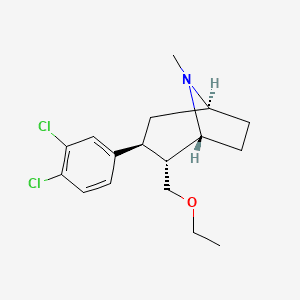
Tesofensine is a synthetic small molecule — not a peptide — built on a phenyltropane scaffold: an 8-azabicyclo[3.2.1]octane (tropane) core bearing a 3,4-dichlorophenyl group and an ethoxymethyl side chain, with four defined stereocentres (1R,2R,3S,5S).
Tesofensine is a small molecule — a phenyltropane, built on an 8-azabicyclo[3.2.1]octane (tropane) ring — not a peptide: it contains no amino acid residues and no peptide bonds.
Identity & structure
| Identity | |
|---|---|
| CAS | 195875-84-4 |
| PubChem CID | 11370864 |
| FDA UNII | BLH9UKX9V1 |
| Also known as | NS 2330, NS2330 |
| Research class | Signaling & Neuroactive |
| Structure | |
| Molecular formula | C17H23Cl2NO |
| InChIKey | VCVWXKKWDOJNIT-ZOMKSWQUSA-N |
| Analytical | |
| Average molecular weight | 328.28 g/mol |
| Monoisotopic mass | 327.1157 Da (computed) |
A phenyltropane: an 8-azabicyclo[3.2.1]octane (tropane) core carrying a 3,4-dichlorophenyl group at position 3 and an ethoxymethyl side chain at position 2, N-methylated at the bridging nitrogen, with four defined stereocentres (1R,2R,3S,5S). Both chlorine atoms belong to that dichlorophenyl ring — they are covalently part of the molecule, not a counter-ion — which is why the free base itself is C17H23Cl2NO. A citrate salt is registered under a separate CAS number; the free-base identifiers are the ones used here. Having no amino-acid backbone, it carries no sequence and no residue count.
Reference context
Tesofensine is a synthetic small molecule — not a peptide — built on a phenyltropane scaffold: an 8-azabicyclo[3.2.1]octane (tropane) core bearing a 3,4-dichlorophenyl group and an ethoxymethyl side chain, with four defined stereocentres (1R,2R,3S,5S). It is listed here strictly as an analytical reference entity — it is not sold, stocked, or certified by Lineará, and has no price or certificate of analysis. The data on this page is characterization only: molecular formula C17H23Cl2NO and the values computed from it. No biological activity, mechanism, or use is described or implied.
Listed solely as a characterized analytical reference — no representation is made as to any biological effect. For Research Use Only — not for human or veterinary use.
How Tesofensine is characterized
Identity rests on the molecular formula and mass. Electrospray mass spectrometry (ESI-MS) measures the mass-to-charge ratio of the intact molecule; the average and monoisotopic masses are computed from the verified formula and cross-check the composition. The molecular formula and the scaffold noted above define the composition.
Frequently asked questions
What is Tesofensine?
Is Tesofensine a peptide?
What is the structure of Tesofensine?
What is the molecular formula of Tesofensine?
What are the key chemical identifiers for Tesofensine?
How is Tesofensine stored and reconstituted?
Does Lineará sell Tesofensine?
Is Tesofensine approved for human use?
Data, tools & related references
References
- PubChem — compound identity, structure & computed properties (CID 11370864). PubChem →
- CAS Registry Number 195875-84-4.
- FDA Global Substance Registration System — UNII BLH9UKX9V1.
Research professionals only
Reference data
This monograph is characterization reference data. Lineará does not sell, stock, or certify Tesofensine.