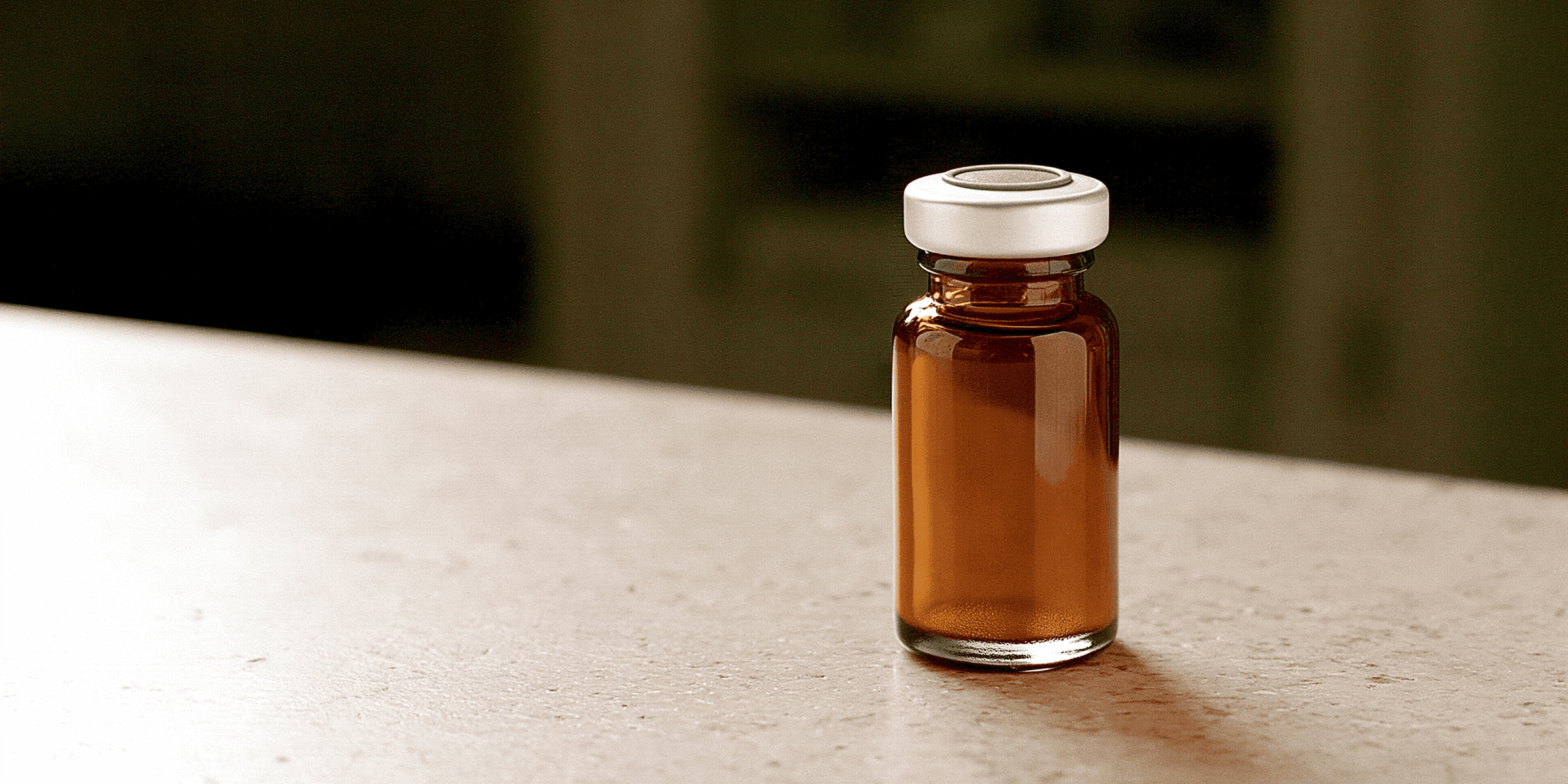
Two ways a peptide falls apart #
"Stability" sounds like one property, but for a peptide it splits cleanly into two categories, and the distinction is the key to everything that follows. The canonical framing, laid out in Manning and colleagues' foundational review of protein pharmaceutical stability, separates chemical instability from physical instability.1
Chemical instability is any change to the molecule's covalent bonds — the atoms themselves rearranging or being cut. The principal pathways are hydrolysis (a peptide bond cleaved by water), deamidation (asparagine or glutamine side chains losing their amide group), oxidation and sulfoxidation (oxygen-sensitive residues like methionine, tryptophan, and cysteine picking up oxygen), racemization (a residue flipping its stereochemistry), beta-elimination, and disulfide exchange or scrambling (the wrong cysteines pairing up). Aspartimide formation — an intramolecular rearrangement at certain aspartate motifs — belongs to this same family. Physical instability, by contrast, leaves the covalent structure intact but changes how molecules associate: aggregation, precipitation, denaturation, adsorption onto container surfaces, and fragmentation.1 International stability guidance names deamidation, oxidation, sulfoxidation, aggregation, and fragmentation specifically as the storage-degradation mechanisms an analytical method must be able to catch.2
The practical value of this taxonomy is that it turns "keep it stable" into a list of named enemies. Every storage recommendation that follows is aimed at one or more of these specific pathways.
Why dry, sealed, cold, and dark #
Given that list, the standard storage form almost designs itself. Water is a reactant in hydrolysis and a facilitator of deamidation and aggregation, so removing it is the single biggest lever — which is why peptides are supplied as a lyophilizate (a freeze-dried solid) rather than in solution, and why a peptide in solution is understood to be on a slow chemical clock that the dry solid is not. Keep that solid in a tightly closed, desiccated container to keep atmospheric moisture out; keep it cold to slow the kinetics of every pathway at once; and keep it dark, because light drives oxidative chemistry. Vendor-technical guidance for peptide handling converges on storing the lyophilizate tightly closed and cold — commonly below about −15 °C, with substantially lower temperatures (on the order of −50 °C or below) preferred for long-term storage — and on not keeping peptides in solution, precisely because dissolved peptide slowly degrades.3
The regulatory logic underneath this is worth knowing, with one honest caveat. International guidance on biological-product stability establishes that shelf life must rest on real-time, real-temperature data, that precisely defined storage temperatures should be specified, and that substances which cannot tolerate freezing need explicit handling recommendations.2 The caveat: that particular guideline's formal scope is biotechnological (recombinant) proteins and polypeptides, not chemically synthesized peptides — the degradation chemistry transfers directly, but a careful reader should treat it as a framework rather than a synthetic-peptide-specific rulebook.
It's also worth resisting a false precision here. It's tempting to build a neat table mapping each pathway to an exact temperature, humidity, and pH window, but the well-supported statement is coarser and more honest: heat, moisture, oxygen, light, and unfavorable pH each accelerate one or more of the named pathways, and good storage minimizes all of them at once. The specific kinetics are molecule-dependent and are established empirically, per batch, by stability studies — not read off a universal chart.
Freeze-thaw, briefly and carefully #
One handling detail deserves its own mention because it's easy to get wrong: repeated freeze-thaw cycling. The regulatory framing flags that some substances simply cannot tolerate freezing and require specific handling,2 and the practical consequence for material in solution is to avoid subjecting it to many freeze-thaw rounds — the standard mitigation being to divide a solution into single-use aliquots so each is frozen and thawed only once. This is grounded more in the freeze-intolerance principle than in a large peptide-specific dataset, so it's stated as sound practice rather than a precisely quantified rule.
The reason it's measurable at all #
None of this would matter if you couldn't see degradation happen — but you can, and that's the point that ties storage back to the certificate of analysis. Stability is assessed with the same orthogonal, stability-indicating methods used to establish purity in the first place: reversed-phase HPLC to trend identity, content, and purity over time, and LC-MS to confirm intact mass and catch the mass shifts that mark oxidation or deamidation.42 A degrading peptide doesn't vanish; it redistributes. New peaks appear on the chromatogram and the main peak shrinks — oxidation adds sixteen mass units, deamidation adds one, hydrolysis produces fragments — and the purity number that looked clean on release drifts as the sample ages.
This is the real reason a purity figure is a snapshot and not a permanent property, and why storage is inseparable from characterization: the same analysis that certifies a peptide is the analysis that watches it decline. Store it dry, cold, sealed, and dark, and you're not being fussy — you're slowing a set of reactions you can literally watch on an HPLC trace.
References
- Manning, Patel & Borchardt, Stability of Protein Pharmaceuticals, Pharmaceutical Research 6 (1989) 903–918, PMID 2687836 (taxonomy reaffirmed in the 2010 update, PMID 20143256). Canonical division of chemical vs physical instability and the named degradation pathways. Link →
- ICH Q5C, Stability Testing of Biotechnological/Biological Products. Real-time/real-temperature stability data; precisely defined storage temperatures; explicit handling for freeze-intolerant substances; deamidation/oxidation/sulfoxidation/aggregation/fragmentation as storage-degradation mechanisms methods must detect. Formal scope is recombinant biotech products; applied here as a transferable framework. Link →
- Bachem, Handling and Storage Guidelines for Peptides (vendor-technical; corroborated by Sigma-Aldrich and GenScript handling guidance). Store lyophilizate tightly closed and cold (commonly below ~−15 °C; ~−50 °C or lower preferred long-term); do not store peptides in solution owing to slow degradation. Link →
- McCarthy et al. (USP), Reference Standards to Support Quality of Synthetic Peptide Therapeutics, Pharmaceutical Research 40 (2023), DOI 10.1007/s11095-023-03493-1; open text PMC10338602. RP-HPLC for identity/content/purity/stability trending and electrospray LC-MS/MS for mass and sequence. Link →